The Mortgage Ends, But The Tax Bill Doesn't: Inside America's Property-Tax Revolt
Read this article in:
Paying off a home ends the mortgage. It does not fix the cost of keeping the house. That distinction is becoming the economic fault line beneath America's widening property-tax revolt.
A rising valuation looks like prosperity on a balance sheet. The tax bill arrives in cash. For an owner who wants to stay put, extracting that additional wealth generally means borrowing against the house or selling it. Neither is quite the financial security that paying off a mortgage was supposed to deliver.
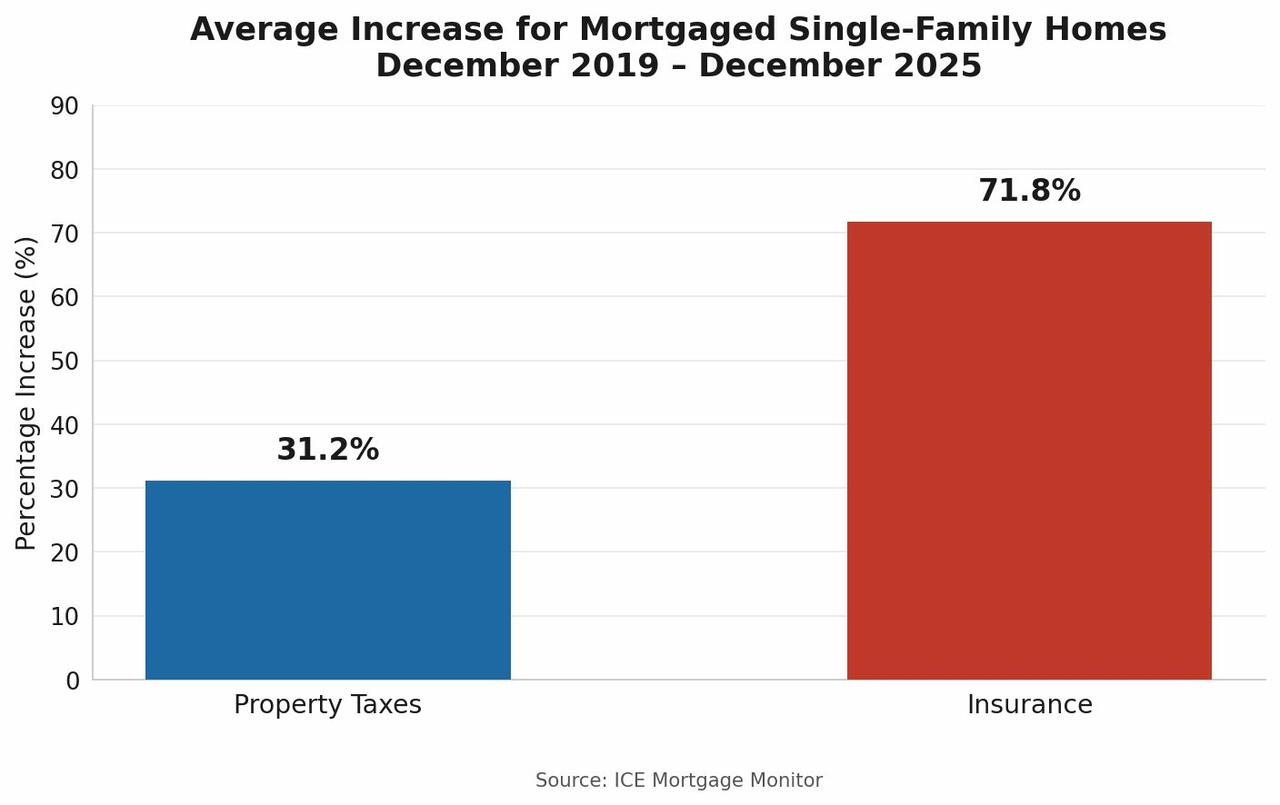
The pressure extends well beyond a few angry retirees. ICE's mortgage data show average property-tax payments on mortgaged single-family homes rose 31.2% between December 2019 and December 2025. Insurance payments increased 71.8%.
Meanwhile, Harvard's Joint Center for Housing Studies reports that 20.7 million homeowner households spent more than 30% of their income on housing and utilities in 2024. Even among owners without a mortgage, 16% were burdened by housing costs.
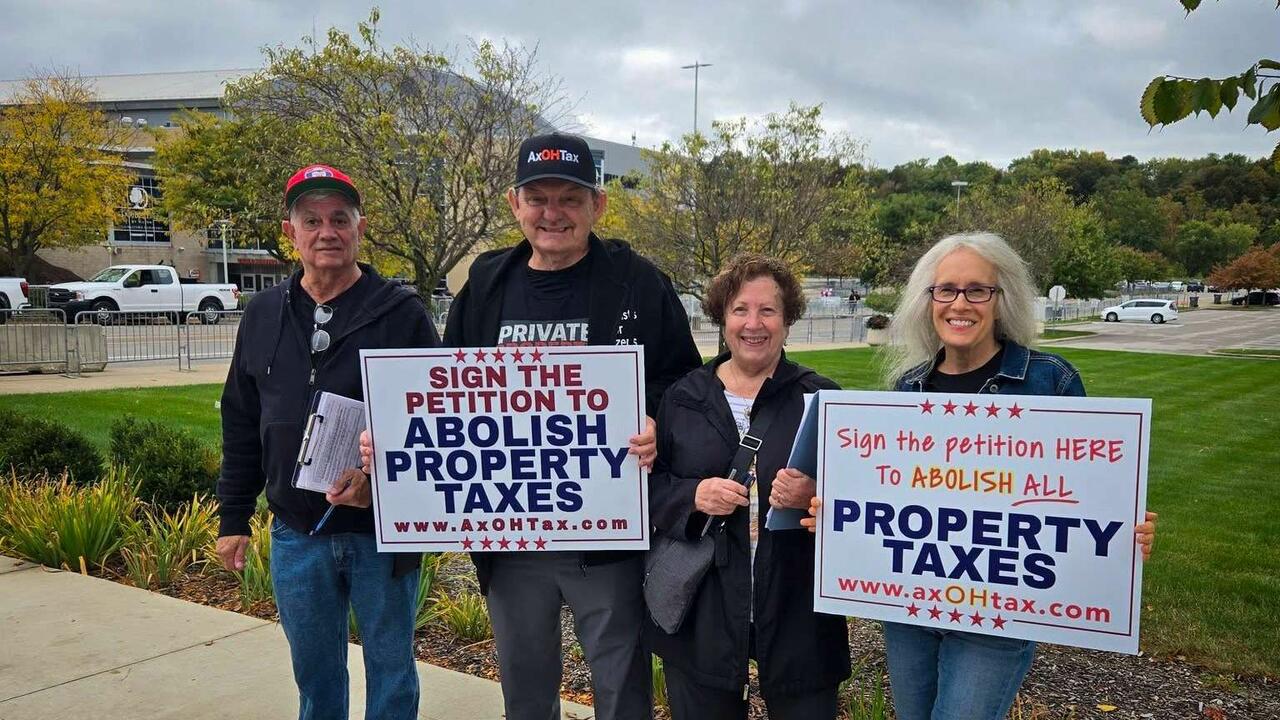
That is the broader setting for the Ohio homeowner Politico encountered signing a petition to abolish property taxes. Ray Warner, 72, put the grievance plainly: "I'm old. I've paid my home off. Why would I pay property tax?"
The question mixes a budget problem with a claim about ownership. The current revolt draws its force from both.
Paper Wealth, Cash Bills
Homeowners with fixed-rate mortgages have protection against changes in their loan's scheduled principal-and-interest payment. Their taxes and insurance have no equivalent nationwide guarantee. Paying the mortgage off removes the lender's payment, while leaving those other expenses in place. According to the Census Bureau, about 35 million homes owned free and clear in 2024, representing 40.3% of owned homes.
Boomers celebrating the fact that they had the chance to purchase gold at $17, a house at $35,000 and paid $250 to go to a 4 year college while still getting handouts from the goverment in 2026 https://t.co/8futFDA6sI
— Dividend Hero (@HeroDividend) January 26, 2026
Insurance compounds the problem. In its September 2026 update, ICE put average insurance costs for single-family mortgage holders at $209 a month in the second quarter, nearly 80% above the start of 2020. The pace of increases was slowing, but the level remained high.
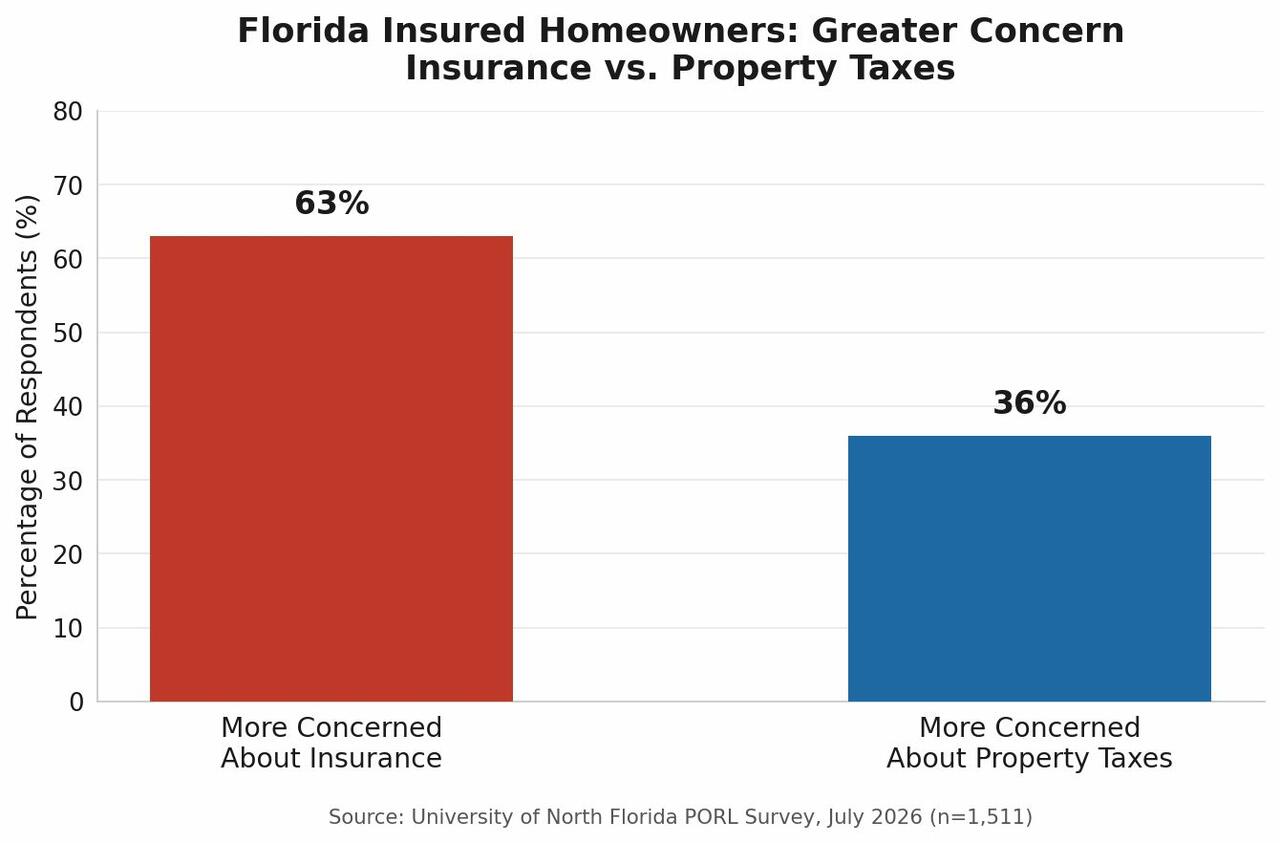
A University of North Florida survey released in September illustrates the distinction. Among 1,511 insured Florida homeowners surveyed in July, 63% were more concerned about insurance than property taxes; 36% chose taxes.
That suggests one reason property taxes have become a political target: they are a recurring housing expense voters can attack directly through elections and ballot measures. Cutting them can provide real relief, but it cannot by itself resolve the full cost of ownership.
The Housing Boom's Delayed Invoice
Tax assessments do not update everywhere on the same schedule. Cotality's research on pandemic-era tax increases describes how reassessment cycles delay the translation of market gains into tax notices. Exemptions, local tax rates and limits on collections further complicate the relationship.
The resulting frustration can outlast the price boom. ATTOM's 2025 analysis found the average single-family tax bill rose 3% to $4,427 even as its average estimated home value fell 1.7%. That does not establish why every bill increased, but it shows that weakening valuations and higher taxes can coexist.
There is an essential qualification to the national story. Politico cites a roughly 25% increase in median annual property-tax payments between 2019 and 2024. Bureau of Labor Statistics figures show annual-average consumer prices rose about 22.7% during those years. Using the rounded tax figure, the increase after inflation is approximately 1.9%.
The national median therefore does not establish an extraordinary inflation-adjusted tax surge. It also cannot describe the household facing a much larger reassessment, or one whose disposable income has failed to keep pace with expenses. The national median is poor comfort when the local bill arrives.
Local Budgets Enjoyed The Boom, Too
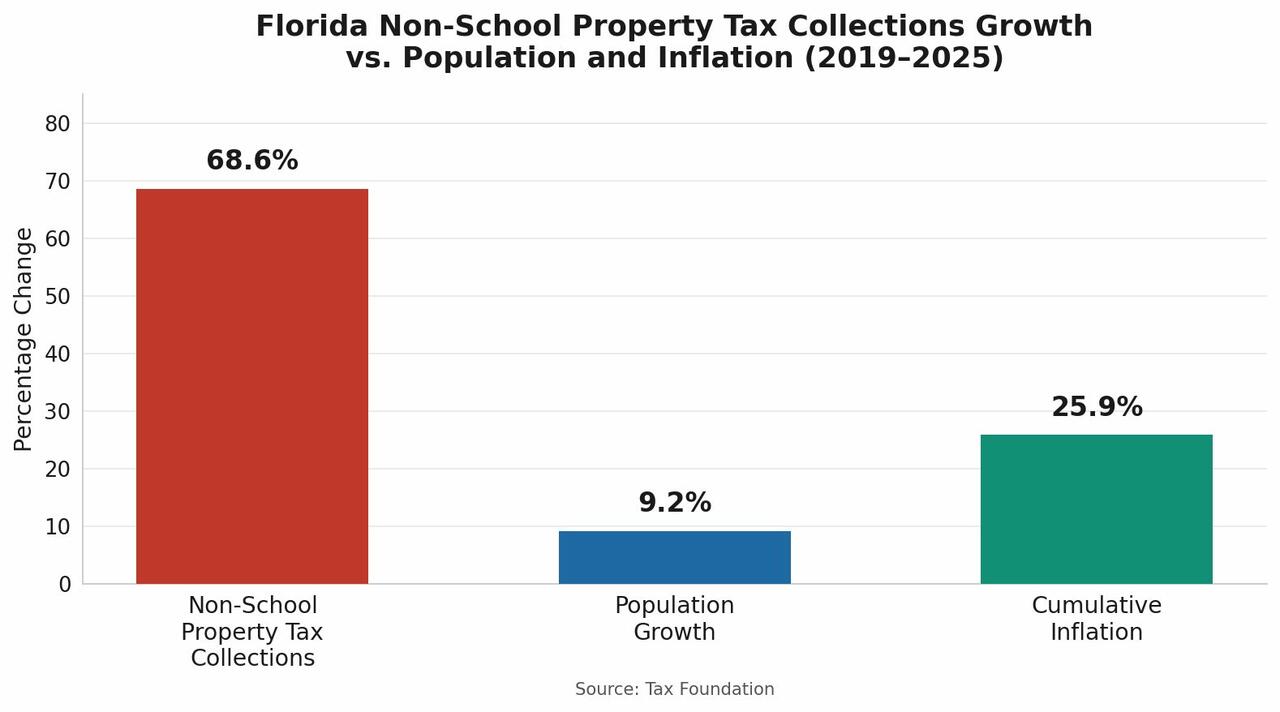
The case for restraining local revenue growth deserves scrutiny on its own terms. In an analysis published October 20, the Tax Foundation reports that Florida's non-school property-tax collections increased 68.6% from 2019 to 2025, compared with population growth of 9.2% and cumulative inflation of 25.9%.
Adjusting those figures for population and inflation implies roughly 22.6% growth per resident. That does not establish waste; construction and changing service demands matter. It does make the local revenue growth worth scrutiny.
A larger assessment does not mathematically require a proportionately larger bill. Consider a simplified example: $300,000 of taxable value at a 1% rate produces a $3,000 bill. If taxable value rises to $450,000, lowering the rate to about 0.667% preserves the same dollar payment. Actual tax systems have additional rules, but the arithmetic makes the policy choice clear.
Politico found that tension inside city hall. Charlestown, Indiana, Mayor Treva Hodges described budget cuts after state tax relief, while also fighting a reassessment that she said increased her own home's value by about 45% and its tax bill by $650.
The two positions can coexist. A homeowner can have a legitimate complaint about an assessment, and a municipality can still need an explicit plan for the revenue being removed.
What "Abolition" Actually Means
The movement encompasses significantly different policies. Treating them all as repeal obscures both the benefits and the costs.
Florida: Amendment 3, on the November 2026 ballot, would raise the homestead exemption for non-school property taxes to $150,000 in 2027 and $250,000 in 2028, with inflation adjustments afterward. School levies remain. This is a large exemption expansion, with additional assessment and implementation provisions, rather than immediate repeal of all property taxes.
Texas: The current school-district homestead exemption is $140,000, plus an additional $60,000 for qualifying older or disabled owners. Those are reductions in taxable value; they are not checks for those amounts and do not eliminate every local levy.
Ohio: Organizers are aiming for November 2027, after abandoning an effort to qualify for this year's ballot. The proposal examined by the state's Legislative Service Commission would abolish taxes on real property, while leaving public-utility tangible-personal-property taxes in place. Its September 2025 fiscal analysis identified $21.41 billion in real-property taxes charged in tax year 2024, within $23.93 billion in total property taxes.
Politico's Ohio organizer, Brian Massie, describes his campaign in terms of freedom and private property. Legislators translating that principle into law still have to decide which property, which owners and which obligations are covered.
The Power To Take The House Is Real
The security argument has a legal foundation. In Pung v. Isabella County, decided June 23, 2026, the Supreme Court described a Michigan property-tax dispute involving $2,241.93 owed and a house assessed at $194,400 that sold at a tax auction for $76,008.
The Court held that a fairly conducted tax sale's price, rather than hypothetical market value, generally sets the constitutional compensation baseline. Owners retain the right to surplus proceeds after the tax debt is satisfied. The case was sent back for further proceedings, including any properly preserved challenge to the sale's fairness.
Protection against the government keeping surplus proceeds does not guarantee recovery of the home's full market value. That distinction helps explain why a tax bill can be experienced as a threat to ownership itself.
The Money Has To Come From Somewhere
The fiscal stakes are enormous. Census data put state and local property-tax collections at approximately $846 billion over the four quarters ending in June 2026. That includes commercial and other taxable property, not only owner-occupied homes.
Florida's official July revenue estimate puts Amendment 3's conditional reduction in non-school local revenue at about $4.9 billion in fiscal 2027-28 and $8.7 billion in 2028-29. Those are projected annual impacts if voters approve the amendment, before assuming compensating policy choices.
A Tax Foundation scenario illustrates the scale of complete repeal: replacing all Ohio property-tax revenue with additional income taxes would produce an estimated average combined state and local income-tax rate of 12.59%. The model covers a broader tax base than the real-property-only initiative described above. It is neither an enacted rate nor an unavoidable forecast; spending cuts would reduce the amount to be replaced.
The honest debate therefore has to name the spending reductions, replacement taxes or transfers. Saying the state will cover the difference merely moves the question to another budget.
Texas already illustrates that distinction. Its Education Agency explains that the enlarged exemptions come with additional state aid to protect school districts against the resulting revenue loss. Homeowners receive relief while more of the financing responsibility shifts to the state.
Ohio's fiscal analysis also identifies a less obvious possibility: fixed-dollar levies could place additional obligations on utility property that remains taxable, potentially feeding through into regulated utility charges. A property-tax cut and an electricity bill need not be unrelated.
Relief For Owners Can Shift Costs To Everyone Else
If local governments respond to a homeowner exemption by raising rates on the remaining tax base, rental property and businesses can bear more of the burden. The ultimate effect on renters depends on market conditions; a landlord cannot necessarily pass on every additional dollar.
There is, however, direct evidence of substantial pass-through in one setting. A December 2025 Philadelphia Fed working paper by Sarah Baker, using Berkeley rental data, estimates that landlords passed 50 to 89 cents of each dollar of property-tax shocks into new tenants' rents. That is evidence from a particular market, not a nationwide forecast.
Buyers face another complication. A working paper revised in August 2026 by Joshua Coven, Sebastian Golder, Arpit Gupta and Abdoulaye Ndiaye examines how recurring property taxes affect prices and housing allocation. Lower carrying costs can be capitalized into higher purchase prices, allowing existing owners to capture part of the benefit when they sell.
Reducing the cost of staying in a house therefore does not automatically reduce the cost of entering the housing market by the same amount. An affordability policy should be evaluated from both sides of the transaction.
California offers a historical warning about institutional consequences. According to its Legislative Analyst's Office, Proposition 13 immediately cut property-tax payments by roughly 60%, shifted significant allocation authority to the state, and encouraged cities and counties to rely more heavily on sales, hotel and utility taxes. It delivered substantial relief while also changing who collected revenue and who controlled its distribution.
A revolt against government can end with more fiscal power in the state capital.
Popular Relief, Difficult Arithmetic
North Dakota shows that rejecting repeal does not end the demand for relief. Voters rejected its broad abolition measure in 2024. In May 2025, the state raised its annual primary-residence credit from $500 to $1,600 and adopted a 3% cap on growth in local property-tax budgets. The cap applies to budgets, rather than guaranteeing that each household's bill rises no more than 3%. Earnings from the state's Legacy Fund finance the credit.
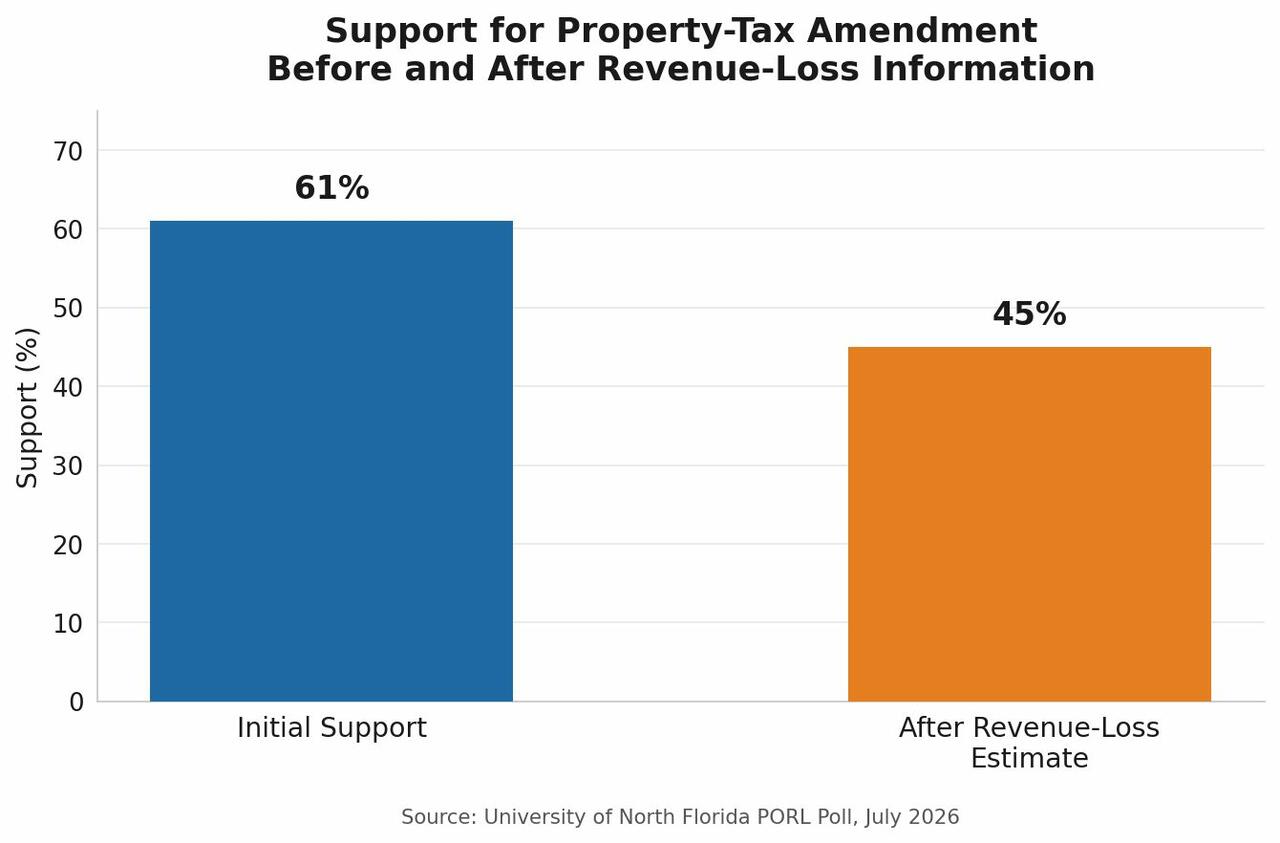
The political coalition becomes less certain when voters are asked about the consequences. In a July University of North Florida poll, support for a described property-tax amendment was 61%. After respondents were given a municipal revenue-loss estimate, support fell to 45%. These were successive questions in the same survey, not an election forecast or a measured collapse in support over time.
The result does not show that households are content with their bills. It shows that support for relief and agreement on how to finance it are separate political achievements.
A serious reform package can address several problems directly. Limits on total levies constrain collections more directly than a simple tax-rate cap, although they do not protect every individual owner equally. Income-based circuit breakers target bills that consume too much of a household's income. Deferrals can reduce immediate pressure on cash-poor owners, while leaving an obligation to be settled later.
Each approach requires choices about spending, eligibility and financing. Blanket exemptions provide broader relief, including to households that do not face hardship. Targeted programs provide less sweeping relief but can focus resources on the risk that gives the revolt much of its force: losing a home because an annual bill has outrun the ability to pay.
For homeowners, the immediate demand is understandable. Paper appreciation should not be mistaken for an unlimited supply of cash. For politicians, the test is whether they can turn that grievance into durable relief without disguising where the bill goes next.
The mortgage can end. The struggle to afford the house can continue.