US Producer Prices Come In Hot On Heels Of Mysterious Energy Cost Surge
Read this article in:
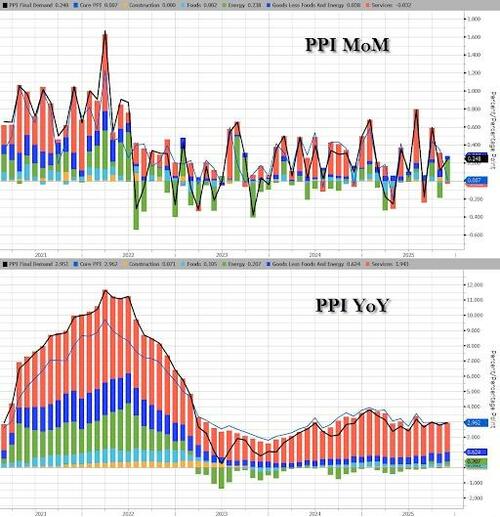
US wholesale inflation picked up slightly in November from a month earlier on a jump in energy costs, even as prices for services were unchanged.
The producer price index rose 0.2% after climbing 0.1% in the prior month, according to much-heralded BLS.
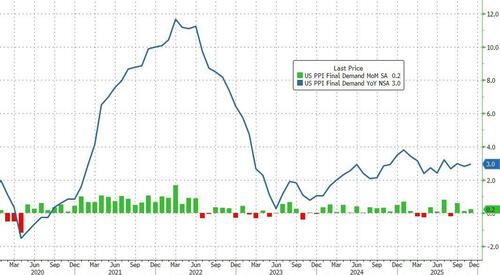
Source: Bloomberg
PPI Final demand goods:
- The index for final demand goods advanced 0.9 percent in November, the largest rise since moving up 0.9 percent in February 2024. Over 80 percent of the November increase can be traced to prices for final demand energy, which jumped 4.6 percent.
- The index for final demand goods less foods and energy advanced 0.2 percent, while prices for final demand foods were unchanged.
Product detail:
- More than half of the November rise in the index for final demand goods is attributable to prices for gasoline, which moved up 10.5 percent.
- The indexes for electric power, diesel fuel, fresh fruits and melons, jet fuel, and light motor trucks also increased. (Most new-model-year passenger cars and light motor trucks were introduced into the PPI in October and November.
- In contrast, prices for residual fuels declined 8.6 percent. The indexes for beef and veal and for basic organic chemicals also decreased. (See table 2.)
PPI Final demand services:
- Prices for final demand services were unchanged in November following a 0.3 percent increase in October.
- In November, the indexes for final demand services less trade, transportation, and warehousing and for final demand transportation and warehousing services both advanced 0.3 percent.
- Conversely, margins for final demand trade services fell 0.8 percent.
Product detail:
- Within final demand services in November, prices for bundled wired telecommunications access services rose 4.6 percent.
- The indexes for machinery and vehicle wholesaling, portfolio management, outpatient care (partial), and game software publishing also moved up.
- In contrast, margins for health, beauty, and optical goods retailing decreased 4.3 percent.
- The indexes for automobile retailing (partial), chemicals and allied products wholesaling, guestroom rental, and food and alcohol retailing also declined.
Excluding food and energy, the PPI was unchanged from the prior month and climbed 3% from November 2024.
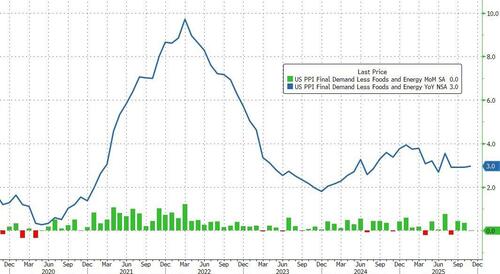
Source: Bloomberg
Economists and investors closely track the PPI because several of its components feed into the Federal Reserve’s preferred inflation gauge, the personal consumption expenditures price index.
Among those categories, portfolio management fees advanced 1.4% while costs of airline passenger services fell 2.6%. The costs of physican care and hospital inpatient care rose slightly, while hospital outpatient care saw a bigger increase.
However, we are not quite sure where the prices surge seen in PPI data is coming from, as oil prices were still plummeting when this data was 'created'...
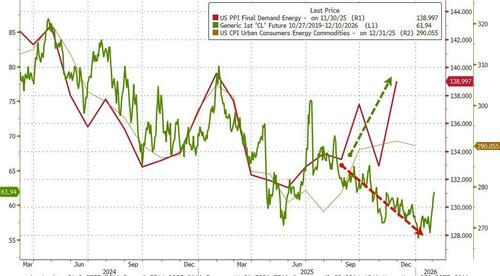
Source: Bloomberg
Still, the lack of a PhD on our side means we are surely too dumb to comprehend this divergence.