Pacific Theatre
Part 6
âTerrible Naval Photography Editionâ
By Lestrade aka Unpopular Opinion
First published: June 2, 2022
No freedom of speech in the UK, but fornicate the constabulary I say.
This one melted with very little effort. The pitch for the Battle of Midway is that the Japanese set up
a trap for the Americans by sending multiple ships to attack Midway atoll.
From Wikipedia:
âThe Battle of Midway was a major naval battle in the Pacific Theater of World War II that took
place on 4â7 June 1942, six months after Japan's attack on Pearl Harbor and one month after
the Battle of the Coral Sea. The U.S. Navy under Admirals Chester W. Nimitz, Frank J. Fletcher,
and Raymond A. Spruance defeated an attacking fleet of the Imperial Japanese Navy under
Admirals Isoroku Yamamoto, Chūichi Nagumo, and Nobutake KondŠnear Midway Atoll,
inflicting devastating damage on the Japanese fleet. Military historian John Keegan called it "the
most stunning and decisive blow in the history of naval warfare", while naval historian Craig
Symonds called it "one of the most consequential naval engagements in world history, ranking
alongside Salamis, Trafalgar, and Tsushima Strait, as both tactically decisive and strategically
influential".
Luring the American aircraft carriers into a trap and occupying Midway was part of an overall
"barrier" strategy to extend Japan's defensive perimeter, in response to the Doolittle air raid on 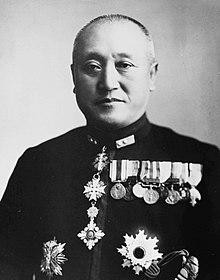
Tokyo. This operation was also considered preparatory for further attacks against Fiji, Samoa, and
Hawaii itself. The plan was undermined by faulty Japanese assumptions of the American reaction
and poor initial dispositions. Most significantly, American cryptographers were able to determine
the date and location of the planned attack, enabling the forewarned U.S. Navy to prepare its own
ambush.
Four Japanese and three American aircraft carriers participated in the battle. The four Japanese
fleet carriersâAkagi, Kaga, SÅryÅ«, and HiryÅ«, part of the six-carrier force that had attacked
Pearl Harbor six months earlierâwere sunk, as was the heavy cruiser Mikuma. The U.S. lost the
carrier Yorktown and the destroyer Hammann, while the carriers USS Enterprise and USS
Hornet survived the battle fully intact.
After Midway and the exhausting attrition of the Solomon Islands campaign, Japan's capacity to
replace its losses in materiel (particularly aircraft carriers) and men (especially well-trained pilots
and maintenance crewmen) rapidly became insufficient to cope with mounting casualties, while the
United States' massive industrial and training capabilities made losses far easier to replace. The
Battle of Midway, along with the Guadalcanal campaign, is widely considered a turning point in
the Pacific War.â
A few things spring to mind immediately.
- If itâs promoted as a big deal by the historians then itâs usually false, or at minimum wildly
twisted.
- We know that the Doolittle Raid was bullshit, because of the faked photos we looked at
previously.
- We know that Pearl Harbour didnât actually involve any Japanese activity, again due to the faked
photos of planes and the nonsense about mini submarines and so on, so the most logical next step is
this will be a fake naval battle to justify the Americans being able to push west.
- We know that Yamamoto gets spirited away (the faked photo with his men, the fan-fiction of
âleaning against a tree holding his swordâ after the plane getting shot down). We also have extreme
scepticism on Nagumo (blatantly a spook, shoots himself in the head in a Saipan cave, later
recovered by Marines).
That leaves us with player 3, our lad Kondo:
His wiki page tells us:
âKondÅ was a native of Osaka. He graduated at the head of his class of 172 cadets from the 35th
session of the Imperial Japanese Navy Academy in 1907. As a midshipman he served on the cruiser
Itsukushima and battleship Mikasa. After his commissioning as ensign, he was assigned to the
cruiser Aso, destroyer Kisaragi and battleship KongÅ. From 1912-1913, he was a naval attaché to
the United Kingdom. After his return to Japan, he served briefly on the FusÅ, then in a number of
staff positions throughout World War I. From 1916-1917, he was chief Gunnery Officer on
Akitsushima.
After the end of the war, KondÅ attended the Naval Staff College, and was promoted to lieutenant
commander on 1 December 1919.
From 1920-1923, KondÅ was stationed in Germany, as part of the Japanese delegation to
confirm Germany's adherence to the provision of the Treaty of Versailles. On his return to Japan,
he was stationed for six months on the battleship Mutsu, and promoted to commander on 1
December 1923. From 1924-1925, he was an aide-de-camp to Crown Prince Hirohito. On
completion of this task, he became an instructor at the Imperial Japanese Navy Academy and was
promoted to captain. He subsequently served in a number of positions on the Imperial Japanese
Navy General Staff. He was captain of the Kako from 1929â1930 and of the battleship KongÅ from
1932-1933.
KondÅ was promoted to rear admiral on 15 November 1933, Chief of Staff of the Combined Fleet in
1935, and vice admiral on 15 November 1937.â
Cool, so heâs a spook. A British asset from the beginning. The naval attaché to the UK bit is a red
flag enough but saying he spent three years living in Germany as part of a delegation to âconfirm
Germanyâs adherence to the Treaty of Versaillesâ is just ridiculous. What, the Japanese need to get
involved in monitoring what Germany are up to after WW1? They didnât do a very good job did
they? Why even involve the Japanese? Wouldnât the British/French/Russians/Americans have
enough admin staff to do this?
Then the cherry on the cake being aide de camp to Hirohito. Thatâs personal assistant to the
Emperor himself â not an insignificant position, this guy is special. So special in fact that his bio
just ends with no details of his death/arrest. You might think someone would want to arrest the man
who was such a prominent member of the Imperial Japanese Navy and was directly involved in
multiple campaigns against the West, including Midway, but nah. He just⦠retires⦠I think? Then
dies in the 1950âs, in Tokyo. I love the idea of the Japanese surrendering and this old Admiral guy
shrugging, taking off his medals and walking off his aircraft carrier whistling, hands in pockets, to
live quietly in retirement.
Again, as weâve consistently seen, the higher-ups in the Japanese forces get to just walk away clear.
Anyway, we read on:
âTypical of Japanese naval planning during World War II, Yamamoto's battle plan for taking
Midway (named Operation MI) was exceedingly complex. It required the careful and timely
coordination of multiple battle groups over hundreds of miles of open sea. His design was also
predicated on optimistic intelligence suggesting that USS Enterprise and USS Hornet, forming
Task Force 16, were the only carriers available to the U.S. Pacific Fleet. During the Battle of the
Coral Sea one month earlier, USS Lexington had been sunk and USS Yorktown suffered so much
damage that the Japanese believed she too had been lost. However, following hasty repairs at
Pearl Harbor, Yorktown sortied and ultimately played a critical role in the discovery and eventual
destruction of the Japanese fleet carriers at Midway. Finally, much of Yamamoto's planning,
coinciding with the general feeling among the Japanese leadership at the time, was based on a
gross misjudgment of American morale, which was believed to be debilitated from the string of
Japanese victories in the preceding months.â
Itâs not a complicated plan. You send in some ships to attack Midway atoll where the Americans are
sitting around fishing. This pisses off the US Navy who send their ships at you. You spread out
your fleet so that when they scout you they think you only have X number of ships but you actually
have more, hidden nearby. This baits a manageable number of Americans into attacking, you then
smash them with an ambush.
The plan relies on a bunch of assumptions, which makes it a bad plan. Apparently the Japanese
have not bothered to set up any kind of scouting / intelligence network prior to or during the war.
Yorktown is repaired at Pearl Harbour, but nobody bothered to inform Japanese naval command, so
they donât know there will be at least one extra carrier. Also nobody could be bothered to read any
American newspapers or listen to their radio broadcasts to gauge public mood. So this whole
paragraph justifying Yamamotoâs plan is ridiculous and only works if we go with normie âI guess
they were all just really stupidâ cope (which I know is what theyâd say if they read this).
âYamamoto felt deception would be required to lure the U.S. fleet into a fatally compromised
situation. To this end, he dispersed his forces so that their full extent (particularly his battleships)
would be concealed from the Americans prior to battle. Critically, Yamamoto's supporting
battleships and cruisers trailed Vice Admiral Chūichi Nagumo's carrier force by several hundred
miles. They were intended to come up and destroy whatever elements of the U.S. fleet might come
to Midway's defense once Nagumo's carriers had weakened them sufficiently for a daylight gun
battle. This tactic was doctrine in most major navies of the time.â
Theyâve put that last sentence in to justify a plan where you spread out your forces so they canât co-
ordinate properly and assist each other. I like how if you have a fleet of ships out on the Pacific they
are magically hidden if you spread them out. As if the Americans donât have
scouts/submarines/spotter aircraft of their own.
âWhat Yamamoto did not know was that the U.S. had broken parts of the main Japanese naval
code (dubbed JN-25 by the Americans), divulging many details of his plan to the enemy. His
emphasis on dispersal also meant none of his formations were in a position to support the others.
For instance, despite the fact that Nagumo's carriers were expected to carry out strikes against
Midway and bear the brunt of American counterattacks, the only warships in his fleet larger than
the screening force of twelve destroyers were two KongÅ-class fast battleships, two heavy cruisers,
and one light cruiser. By contrast, Yamamoto and Kondo had between them two light carriers, five
battleships, four heavy cruisers, and two light cruisers, none of which saw action at Midway. The
light carriers of the trailing forces and Yamamoto's three battleships were unable to keep pace
with the carriers of the KidÅ Butai and so could not have sailed in company with them. The Kido
Butai would sail into range at best speed so as to increase the chance of surprise, and would not
have ships spread out across the ocean guiding the enemy toward it. If the other parts of the
invasion force needed more defense, the Kido Butai would make best speed to defend them. Hence
the slower ships could not be with the Kido Butai. The distance between Yamamoto and Kondo's
forces and Nagumo's carriers had grave implications during the battle. The invaluable
reconnaissance capability of the scout planes carried by the cruisers and carriers, as well as the
additional antiaircraft capability of the cruisers and the other two battleships of the KongÅ-class
in the trailing forces, was unavailable to Nagumo.â
Again, just dumb. I donât want to armchair general this but if we played a game of Red Alert 3 and
you kept your fleet so spread out that different ship types canât support each other so I can smash
your fleet in sections then you deserve to get mocked. This from an Admiral who has studied naval
warfare for years and is their top man.
We read on:
âIn order to obtain support from the Imperial Japanese Army for the Midway operation, the
Imperial Japanese Navy agreed to support their invasion of the United States through the
Aleutian Islands of Attu and Kiska, part of the organized incorporated Alaska Territory. The IJA
occupied these islands to place the Japanese home islands out of range of U.S. land-based bombers
in Alaska. Similarly, most Americans feared that the occupied islands would be used as bases for
Japanese bombers to attack strategic targets and population centers along the West Coast of the
United States. The Japanese operations in the Aleutians (Operation AL) removed yet more ships
that could otherwise have augmented the force striking Midway. Whereas many earlier historical
accounts considered the Aleutians operation as a feint to draw American forces away, according to
the original Japanese battle plan, AL was intended to be launched simultaneously with the attack
on Midway. A one-day delay in the sailing of Nagumo's task force resulted in Operation AL
beginning a day before the Midway attack.â
Beautiful. Weâve already established that the entire Aleutian campaign was made up by the
Americans. Now we see the Aleutians used as a partial justification for why the Japanese lost
Midway.
Coral Sea happens before Midway and Yorktown is supposed to take a pummelling in that, but it
can be fixed up and be shipshape in 72 hours:
âDespite estimates that Yorktown, damaged in the Battle of the Coral Sea, would require several
months of repairs at Puget Sound Naval Shipyard, her elevators were intact and her flight deck
largely so. The Pearl Harbor Naval Shipyard worked around the clock, and in 72 hours she was
restored to a battle-ready state.â
So that was convenient.
Speaking of Coral Sea, this battle was the reason that the Japanese light aircraft carrier Shoho
wasnât able to participate in the attack on Midway, having been sunk. Shoho is also prestigious for
being the first Japanese aircraft carrier sunk in WW2, so thatâs an immediate flag for us to look
more closely.
From the wiki page on the vessel:
âShÅhÅ (Japanese: 祥鳳, "Auspicious Phoenix" or "Happy Phoenix") was a light aircraft carrier of
the Imperial Japanese Navy. Originally built as the submarine support ship Tsurugizaki in the late
1930s, she was converted before the Pacific War into an aircraft carrier and renamed. Completed in
early 1942, the ship supported the invasion forces in Operation MO, the invasion of Port Moresby,
New Guinea, and was sunk by American carrier aircraft on her first combat operation during
the Battle of the Coral Sea on 7 May. ShÅhÅ was the first Japanese aircraft carrier to be sunk
during World War II.â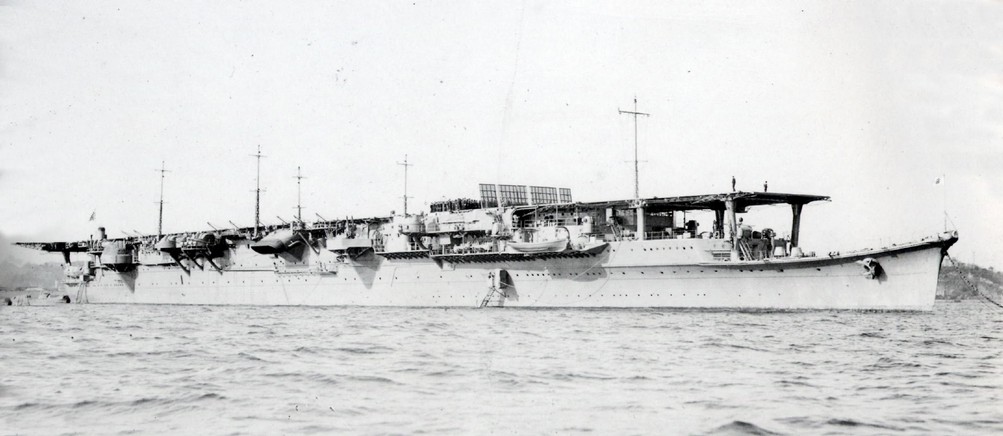
I think the Phoenicians should do more obvious bird related stuff, like the Penguin in Batman
comics â have a strong brand identity. Itâs not like they are trying to be subtle these days. Anyway,
hereâs the Shoho, larger resolution image here:
We then count the numerology markers:
âShÅhÅ and the rest of the Main Force were spotted by aircraft from Lexington at 10:40. At this
time, ShÅhÅ's combat air patrol (CAP) consisted of two A5Ms and one A6M Zero. The Dauntlesses
began their attack at 11:10 as the three Japanese fighters attacked them in their dive. None of the
dive bombers hit ShÅhÅ, which was manoeuvring to avoid their bombs; one Dauntless was shot
down by the Zero after it had pulled out of its dive and several others were damaged. The carrier
launched three more Zeros immediately after this attack to reinforce its CAP. The second wave of
Dauntlesses began their attack at 11:18 and they hit ShÅhÅ twice with 1,000-pound (450 kg)
bombs. These penetrated the ship's flight deck and burst inside her hangars, setting the fuelled and
armed aircraft there on fire. A minute later, the Devastators began dropping their torpedoes from
both sides of the ship. They hit ShÅhÅ five times and the damage from the hits knocked out her
steering and power and flooded both engine and boiler rooms. Yorktown's aircraft trailed those
from Lexington, and the former's Dauntlesses began their attacks at 11:25, hitting ShÅhÅ with
another eleven 1,000-pound bombs by Japanese accounts and the carrier came to a complete
stop. Yorktown's Devastators trailed the rest of her aircraft and attacked at 11:29. They claimed
ten hits, although Japanese accounts acknowledge only two. As the Devastators were exiting the
area, they were attacked by the CAP, but the Wildcats protecting the torpedo bombers shot down
two A5Ms and an A6M Zero. Total American losses to all causes were three Dauntlesses. After his
attack, Lieutenant Commander Robert E. Dixon, commander of Lexington's dive bombers, radioed
his famous message to the American carriers: "Scratch one flat top!"
With ShÅhÅ hit by no fewer than 13 bombs and 7 torpedoes, Captain Izawa ordered the ship
abandoned at 11:31. She sank four minutes later. Some 300 men successfully abandoned the ship,
but they had to wait to be rescued as GotÅ ordered his remaining ships to head north at high speed
to avoid any further airstrikes. Around 14:00, he ordered the destroyer Sazanami to return to the
scene and rescue the survivors. She found only 203, including Captain Izawa. The rest of her crew
of 834 died during the attack or in the water awaiting rescue. ShÅhÅ was the first Japanese
aircraft carrier lost during the war.â
Then we can see these lovely photos that the Americans (?) kindly provide of their mid-battle
bombing runs: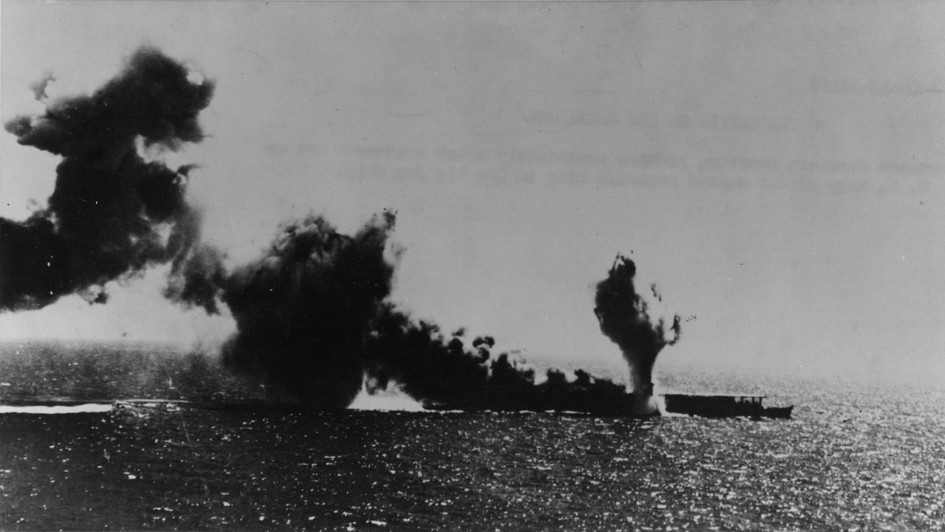
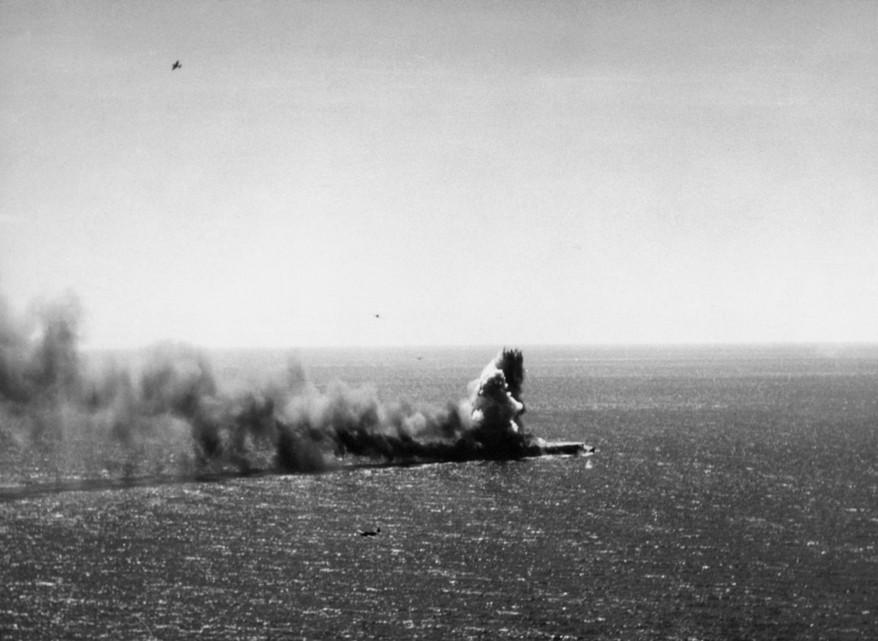
Caption reads: âDramatic shot of the detonation of a 1,000-pound (450kg) bomb on ShÅhÅ during
the Battle of the Coral Sea.â Larger resolution image here.
See the three little silhouettes drawn in of planes in the distance. The sea is nice and flat, washed
out grey horizon, no sky detail. No other ships visible, no other planes in the sky. Except maybe a
huge duck in the foreground. No wait, that's a plane, too, but way too small for the given
perspective. It should be very much larger than the others in the distance, but isn't. Nice vivid
smoke with a white line around the main cloud-head on the centre of the ship and that thick white
line continues around the prow of the ship also. The smoke trailing to the left is so thick that it
creates a black rectangular line on the ocean. Is this meant to be the carriers wake? Or the shadow
of the smoke? The person doctoring this picture couldnât decide so neither can I.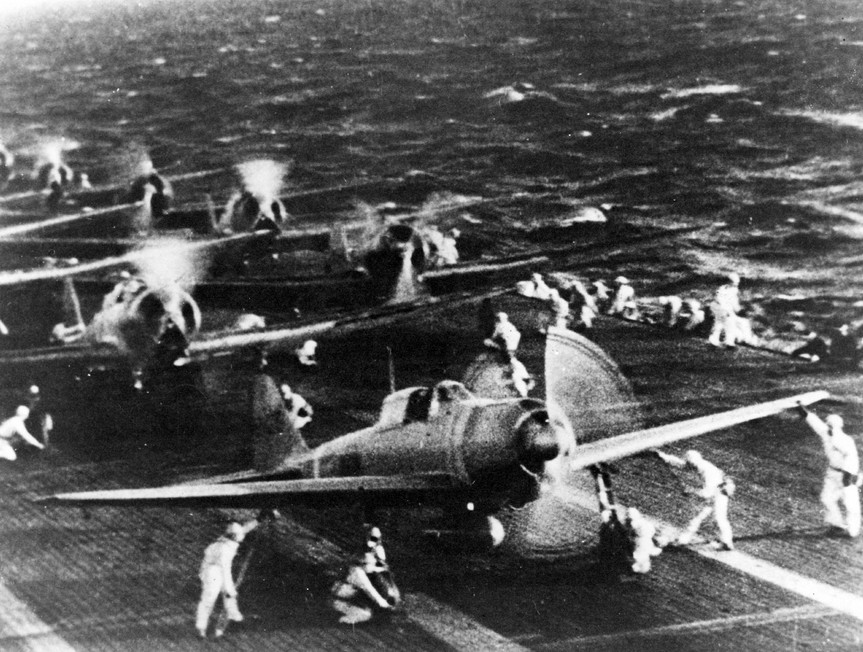
Caption reads: âShÅhÅ hit by a torpedo launched by a Devastator from Lexington.â Higher
resolution image here.
This one makes the first one look professional in comparison. The photography is now an old-timey
image from the 1800s. The sea is very dark and then disintegrates with no clear horizon into a white
sky with no clouds or features (e.g. planes dogfighting) other than multiple horizontal black lines
streaking across the photo. The ship itself is now jet-black silhouette helpfully back-lit at the prow
to give it a nice white outline. A small mushroom cloud blooms. Is this the torpedo impact? To the
left we have jet black smoke and a strange triangular section of white, just completely blank.
Has the wreck of the Shoho ever been found, photographed, investigated? Nope. Is anyone
interested in doing so? Apparently not. Again, another historical ship being sunk and nobody has
bothered to locate it in 70 years.
You can also see some awesomely terrible photos of the Japanese carrier Shokaku on this wiki
page. It âwas sunkâ during the Battle of the Philippine Sea so Iâm skipping ahead there, but just
wanted to include them now as theyâre gold:
Caption reads: âMitsubishi A6M2 "Zero" fighters from the ShÅkaku preparing for the attack on
Pearl Harbor.â Higher resolution version here.
I love the white blurred ghost men helping the drawings/cropped in planes take off. 1 layer of
planes, 1 layer of men, 1 layer of ship deck and a sea backdrop. Paste up.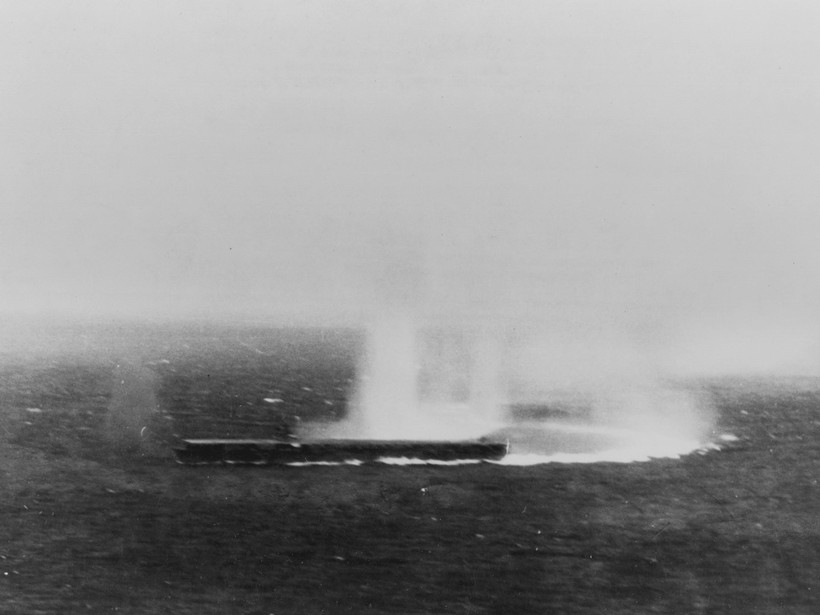
Caption: âThe Japanese aircraft carrier ShÅkaku under attack by planes from USS Yorktown,
during the morning of 8 May 1942. Splashes from dive bombers' near misses are visible off the
ship's starboard side as she makes a sharp turn to the right.â Original photo here.
The ship is using advanced Star Trek technology to create a luminous white energy field around
itself that helps it move quicker through the water. The ship also has a completely different profile
to the ship pictured here, at launch. Looks more like a barge than a carrier.
And last but not least: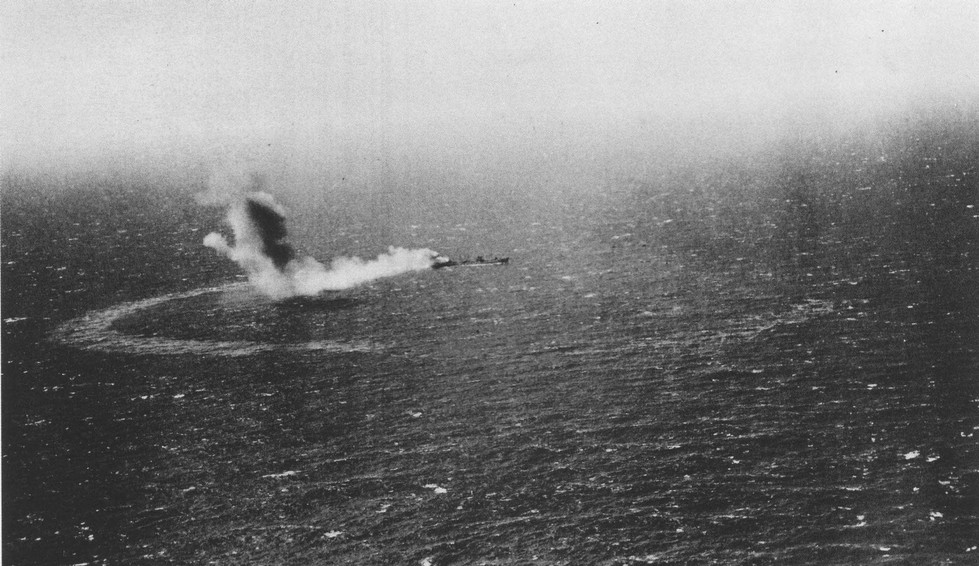
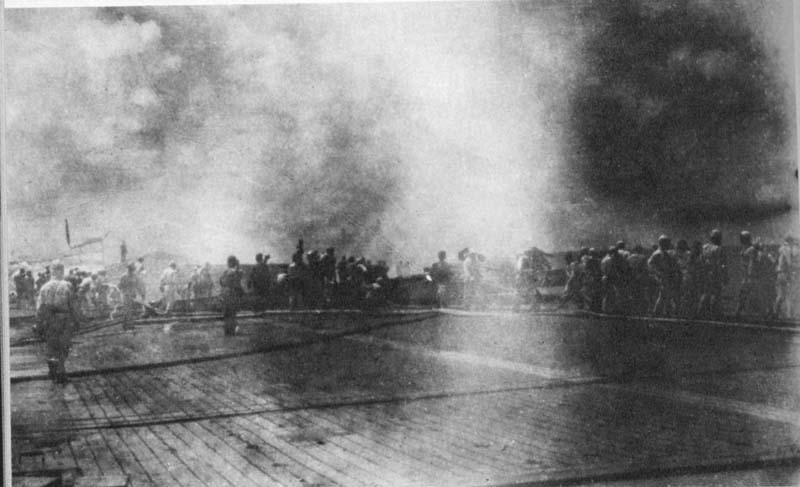
Caption reads: âShÅkaku crewmembers fight fires on the flight deck after being hit by American
bombs during the Battle of the Santa Cruz Islandsâ Original image here.
I like the chap on the far left, standing bolt upright at attention on a shifting deck that is on fire, with
no shadow. Or all the other men, to be fair, who are also layered in. Love that misty smoke effect
they did right down the middle of the image, that is going in front of the men in the background.
Anyway, the above would indicate that the Coral Sea, the Battle of the Santa Cruz Islands and the
Philippine Sea didnât happen (as if they did, why the fakes?). The Wikipedia page on the Coral Sea
fight is just a complete mess when it comes to the photographs to be honest.
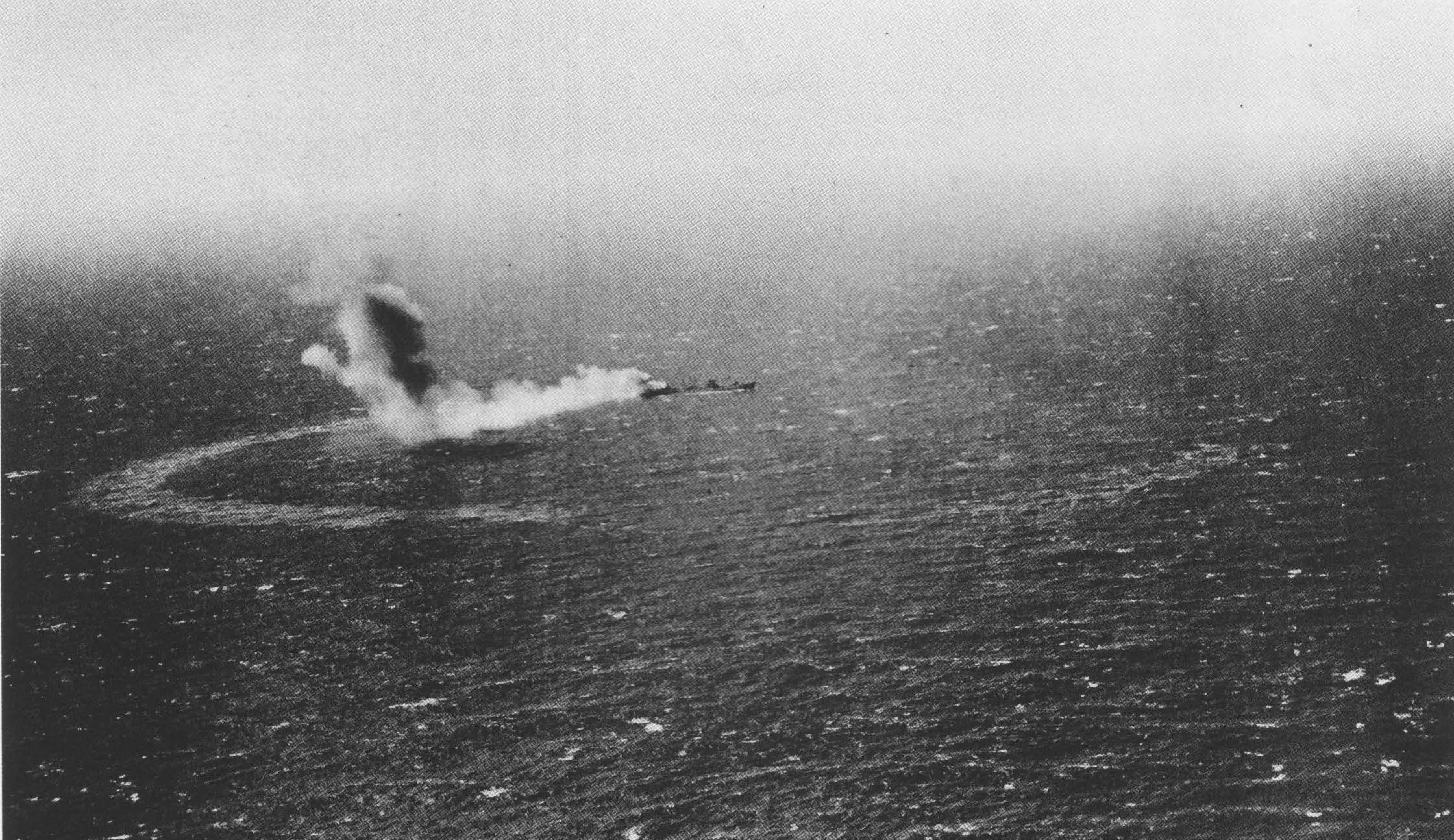
âUSS Neosho is left burning and slowly sinking at the completion of the Japanese dive bombing
attack.â - original image.
Loving that meerkat-shaped white smoke cloud with a solid black shadow on the water under the
base of the cloud. The ship is sailing in a slow circle. No horizon. Whited out sky. On higher
resolution you can zoom in and see the ship appears to be two ships, as there is a gap in the water
between the left and right sections. 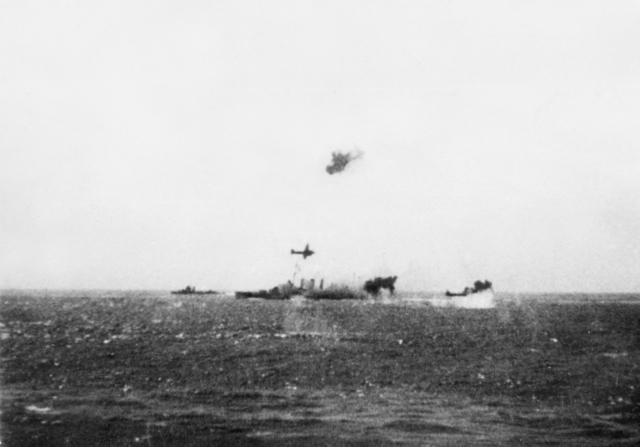
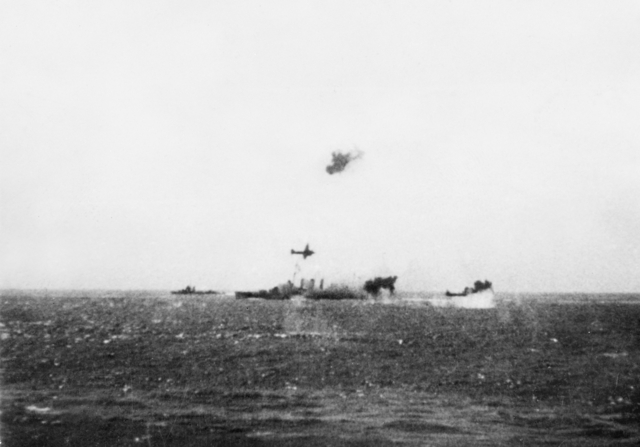
âHMAS Australia (centre) and TG17.3 under air attack on 7 Mayâ â original here.
This one is cute because they got the scale wrong between the plane they want to show bombing the
ship and the ship itself. One flak cloud isnât great either if thatâs meant to be anti-air (which if you
look at footage of anti-air is normally a rapid fire thing that fills the sky with clouds of the stuff).
Also the white chunk in the ocean on the right with a streak of black smoke sat on top. What is that
meant to be?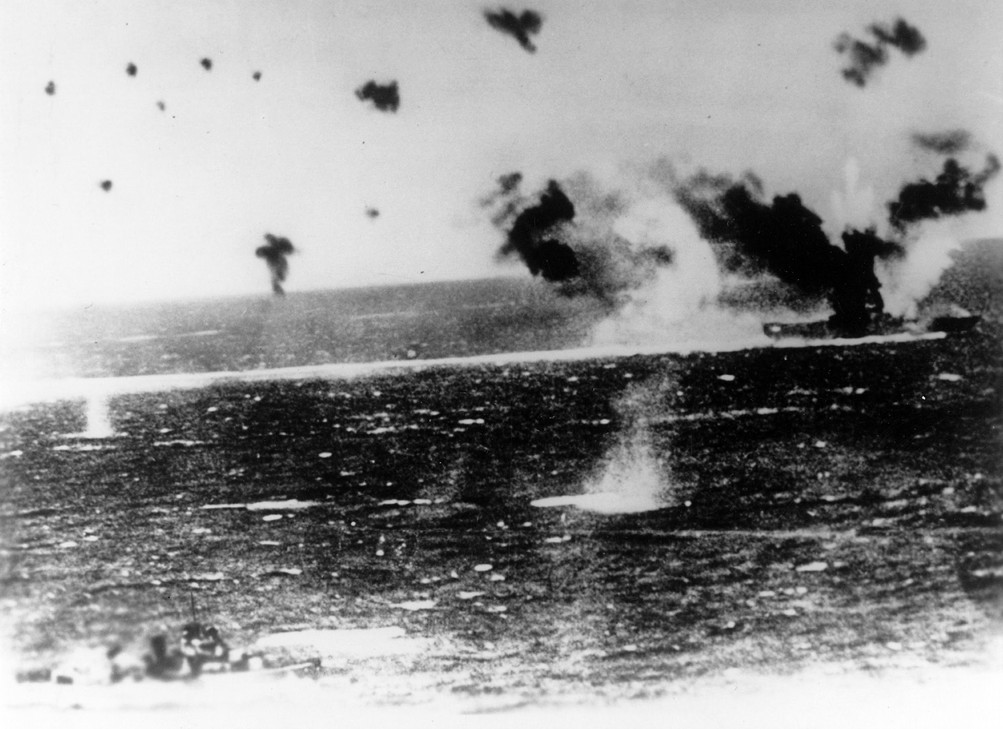
âLexington (centre right), afire and under heavy attack, in a photograph taken from a Japanese
aircraft.â - original here.
They got very enthusiastic about fake explosions on this one and couldnât decide if they wanted
pure white explosions or jet black explosions. The flak is also jet black, on a white-grey sky. A
small nuclear detonation occurs on the horizon to the left, for no particular reason. The ship wake is
pure white on a black sea. They were enjoying themselves so much itâs a shame they forgot to add
planes or any other ships.
The wiki page on the Philippine Sea isnât much better either: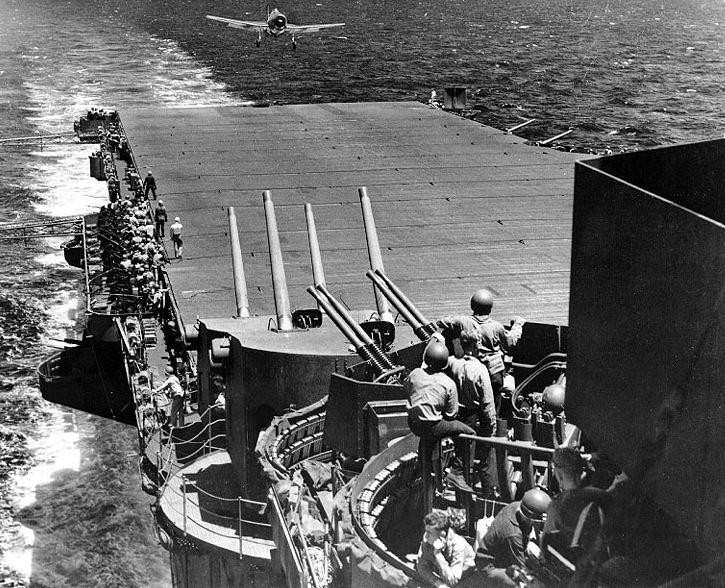
âF6F-3 landing aboard Lexington, flagship of Task Force 58.â - original here.
I think Miles can unpack this better than I, but what Iâm seeing here are two things: layers and
scale. The three men standing on the deck on the centre left are much bigger than the men
immediately to their left on the walkway. The lighting on them has that weird corona/back-lit effect
we see when they insert. The men also appear tiny in comparison to the plane. In terms of layers I
think the plane is inserted (itâs too bright) and the foreground gun-turret section is also inserted. The
three men on the deck are inserted to that central âmiddleâ layer of the main deck and walkway.
Yes, the plane is pasted in, though I don't know why they couldn't use a real photo of a plane
landing. This doesn't prove anything about the war regardless. Planes land in peacetime. 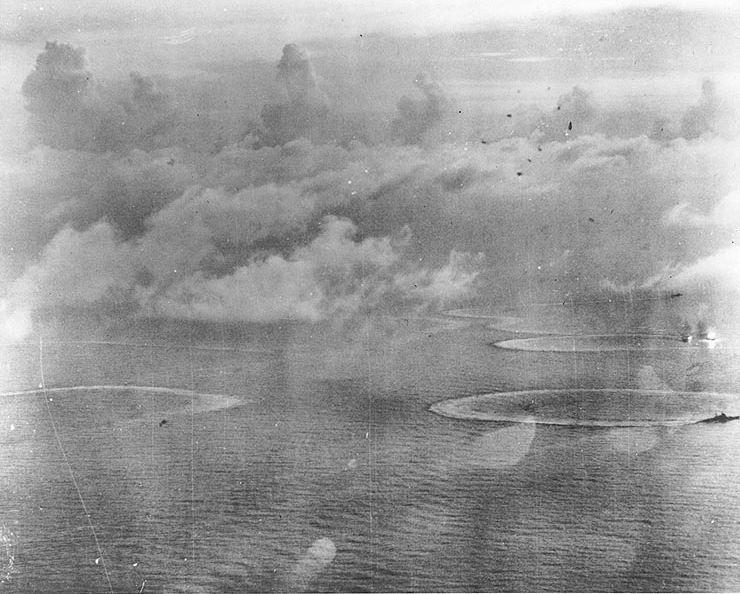
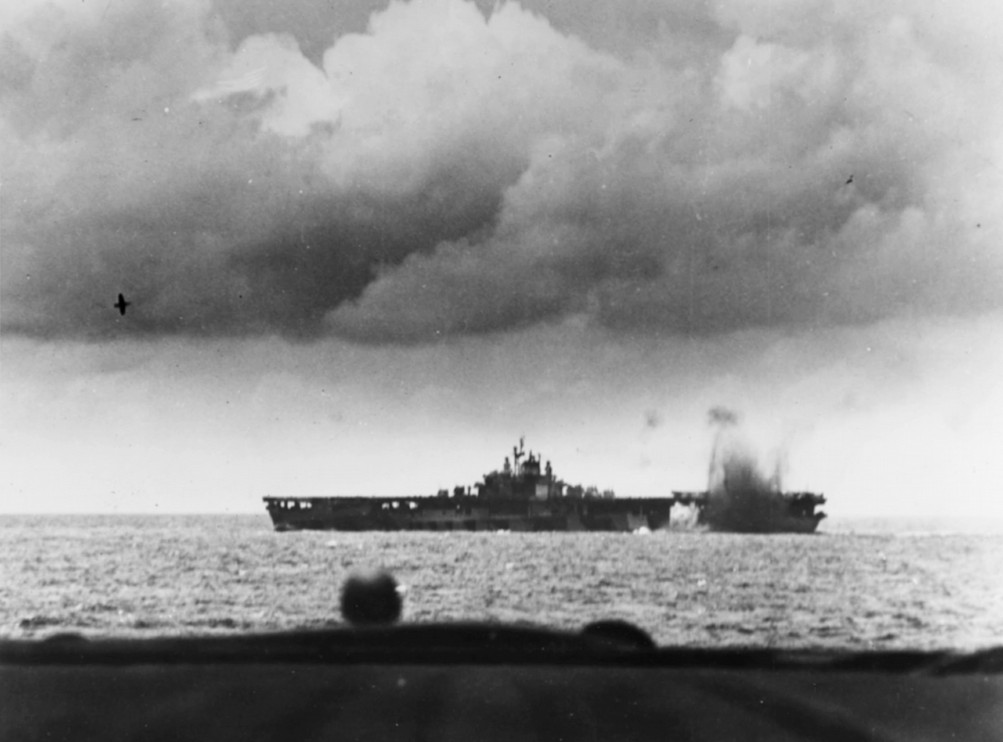
âUSS Bunker Hill is nearly hit by a Japanese bomb during the air attacks of June 19, 1944â -
original here. The plane is drawn in. I suspect theyâve also edited in the white spume and grey
spume effect to the ships aft. Again no other planes, no flak, bone white sky (until you get to the
abrupt cloud layer in the upper third of the image).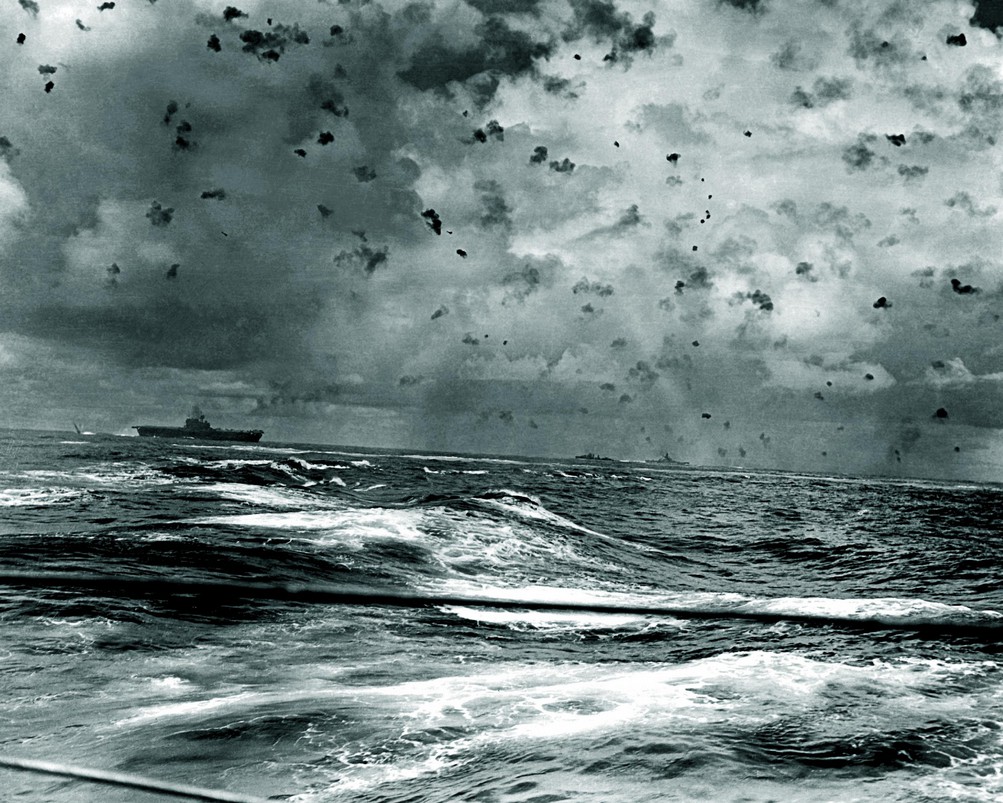
âJapanese Carrier Division Three under attack by United States Navy aircraft from Task Force 58,
late afternoon, June 20, 1944. The heavy cruiser circling at right, nearest to the camera, is either
Maya or ChÅkai. Beyond that is the small aircraft carrier Chiyoda.â - original here.
No idea whatâs going on here. This is a photo from 1944, not the 1800s. Barely any flak, again
drawn in. Jet black ship / plane silhouettes. No horizon. Flat millpond ocean. Why are the ships
moving in tight circles? To benefit the camera crews, no doubt.
Shout out to the guy in Naval Intelligence who clearly loved the âink blotâ effect and went hog wild
with this image from the Santa Cruz Islands naval battle:
âUSS Enterprise (centre left) and her screening ships during the battle, 26 October 1942â â
original here.
Almost painterly. He forgot to add any planes but theyâre more fiddly than just putting blobs (to
represent flak) of varying shades of black. Most of that fake flak is on the camera lens.
In the next cubicle over the intern did his best and ended up doing this one: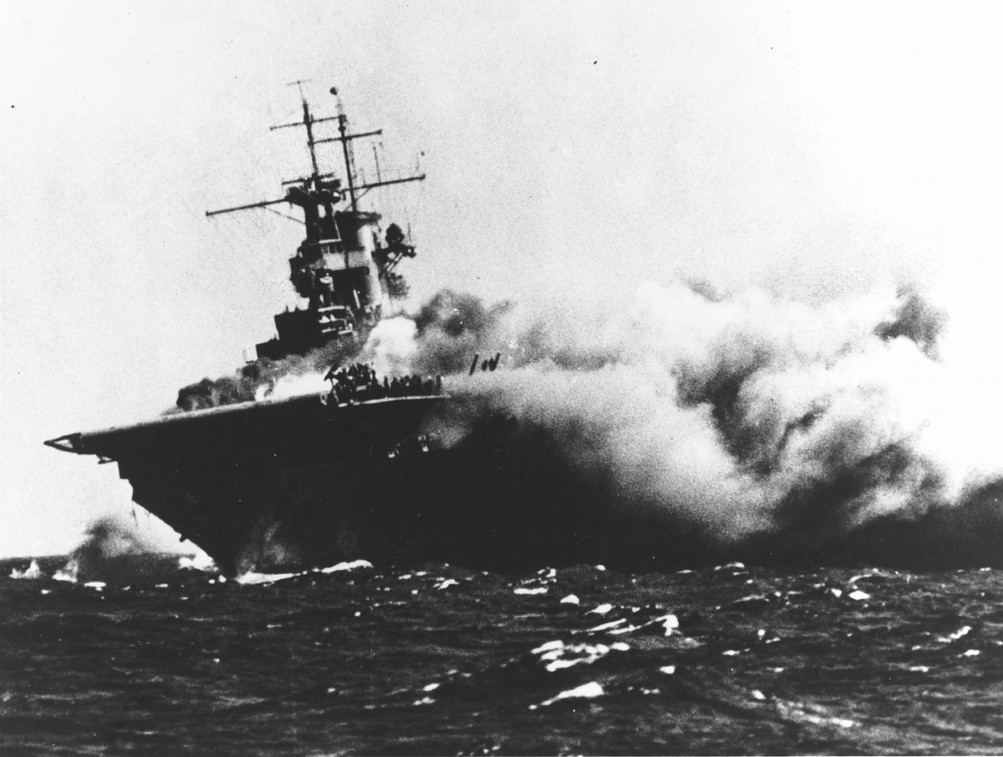
âUSS Wasp burns after being torpedoed on 15 Septemberâ â original here.
Poor effort. Obvious paste up. Black and white ship insert on a white background, then lower third
âchoppy seaâ layer added in, clear line of the ocean all the way across even where thereâs smoke.
Which reminds us that it is strange none of these photos are in color. Color film was patented by
Kodak in 1932, so the Navy certainly had it. You would think they would try it, at least, since even
if the colors faded, they would be no worse than black and white. But it is easier to fake b&w
because then you don't have anyone noticing color anomalies, which point to the fake.
See also this lovely before and after shot, captioned âA damaged Japanese dive bomber (upper left)
dives towards Hornet at 09:14â. Original photo here.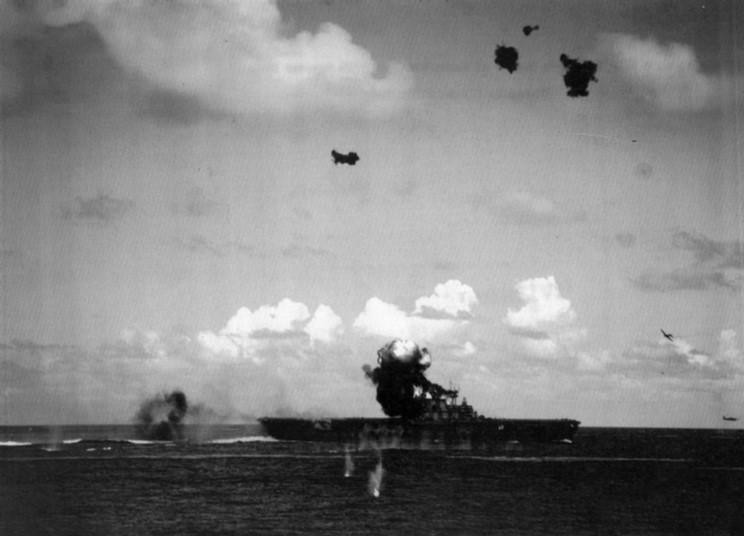
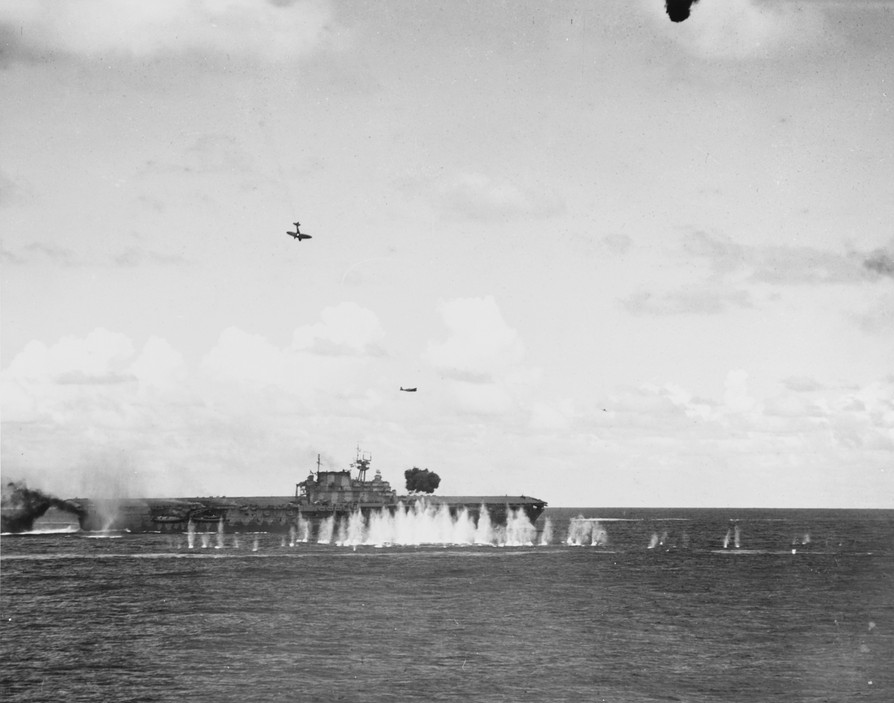
This is the USS Hornet, which of course we have seen before being used in the Doolittle Raid.
So to my eyes, what weâre looking at there is an intact carrier with some planes firing harmlessly at
the water in the foreground and some smoke cropped in on the ship aft. In the extreme top right you
have the edge of some fake âflakâ which is just a black blob on the photo.
Then we have this photo, taken âseconds laterâ: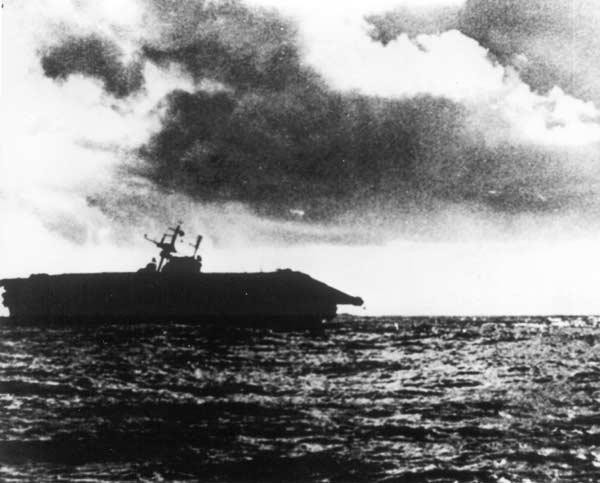
In the âafterâ image they visibly tampered with the gamma levels, hence the sea now being black.
The cluster of black ink blotch âflakâ in the top right is rubbish (why only there? Why not more
flak? Why not more planes?), as is the blobby plane silhouette in the centre. There are two other
plane silhouettes on the lower right, both added in afterwards. Theyâve added in a black âexplosionâ
layer to the ship and some white points in the sea to pretend to be bullet impacts or something with
very large white spume effects.
It was getting late and the chap doing the final photo wanted to clock off and have his dinner, so
then they slapped together this photo:
âHornet, sinking and abandonedâ â original here.
They drop in the carrier silhouette at an angle (to make it look like itâs listing/sinking I guess) and
then have to gamma-correct the sea and the sky, which makes the sky washed out and weird looking
(see the clouds versus the sky itself versus the water shade I mean). Easier to see on the larger
original image but the carrier silhouette wasnât even cropped properly so the bottom of the ship
outline overlaps at the waterline to create that deep black shadow effect (I hope that makes sense,
Iâm saying that the sea wouldnât be that dark there, itâs dark because itâs two layers overlapping in
the collage). Despite being repeatedly torpedoed thereâs no smoke/fire. Also no planes or flak in the
sky and no other ships or crewmen / life boats in the water, etc. etc.
Of course Iâm just a mean old cynic because Microsoft co-founder Paul Allen and his investigation
ship the Petrel have located the wreck of the Hornet in 2019, as per this article. The crew send down
a robot probe and spot the carrier on the sea bed. Thereâs a lot of talk about positive identification 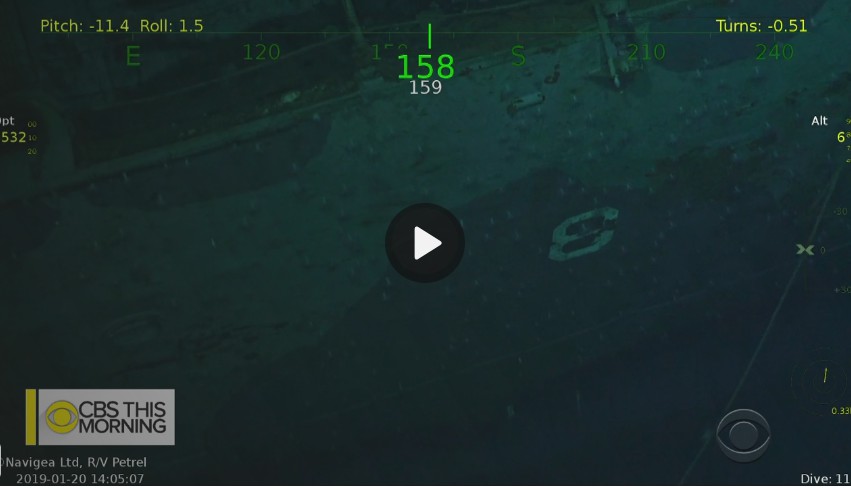
and even a photo gallery section on the article page but at no point do we actually see the âC-V-8â
designation in either the video or the gallery.
I grabbed this, which is the split-second view of whatâs supposed to be the bombshell proof:
Is that an 8? Or a 3? Which part of the ship is it on? If you look at the Wikipedia article on the
Hornet, with multiple photographs of the ship when itâs just been launched and sailing around
normally, where is the giant 8 painted?
I have half a mind they then did a Titanic and filmed a miniature model in a fish tank. What do you
think, Miles? Yeah. That lake in Glendale.
CNN helpfully tell us that:
âthe crew of the Petrel who were honoured to find the Hornet and the final resting place of so many
of her brave crew. Another wreck, and in turn, another war grave has been discovered. Its exact
location is kept secret to protect it, but the memory now has a place and the loss has a memorial.â
Very sensible. If they told us where it was then someone else could check it out to confirm itâs real
absolutely anyone could dive over 17,000 feet to steal a ship from the ocean floor of the Solomon
Islands.
So thatâs a load of made-for-TV nonsense. Quite elaborate really. They could have just said âwreck
never foundâ.
Anyway, a bit of a diversion there, I hope the reader will forgive me but weâve just âsunkâ (ahaha)
four major naval battles. Iâm sure with a bit of digging / browsing you will spot many other aspects
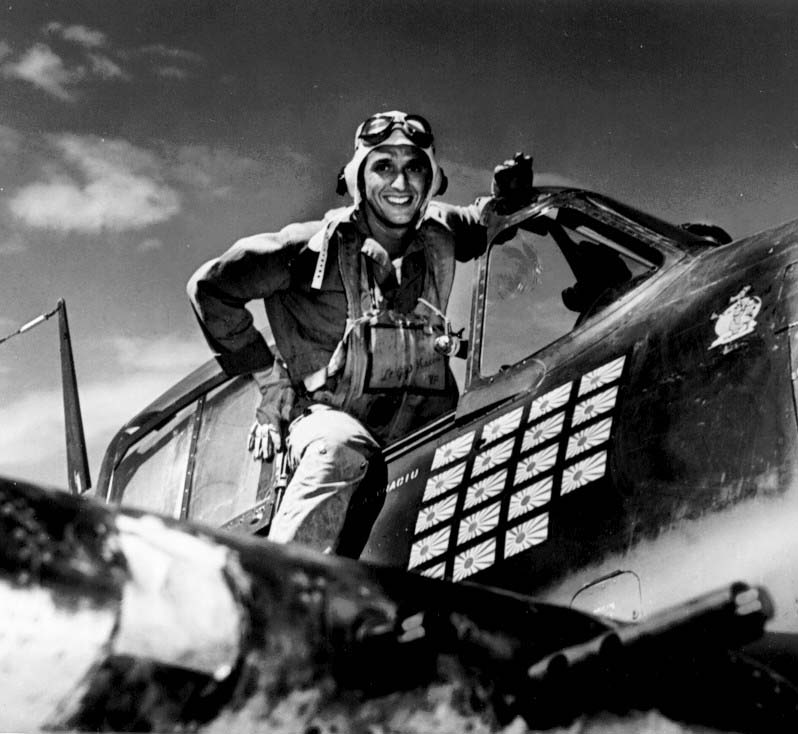
of these events that are suspect, for example the terrifying giant floating head of US Navy fighter
ace Alexander Vraciu. 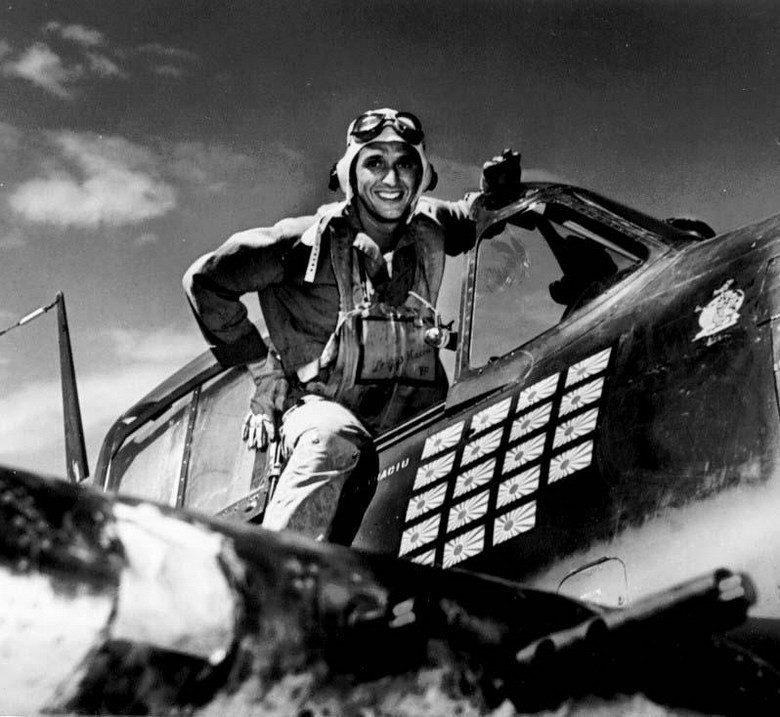
Yes, good catch, definitely a fake.
Returning to Midway, I would recommend you watch this hilariously bad War Academy Film
Collection copy of the Battle of Midway. Here is a link. This quite neatly explains what happened
on the atoll: they flew out a film crew, they set fire to a single hanger/warehouse building to create a
big black smoke cloud and they did some exercises firing machine guns and flak at the sky. Those
will be American planes, obviously, not Japanese planes. Nobody is getting shot and only one
building is damaged (it looks like an old hangar and I imagine they emptied it of anything important
beforehand). In the second half of the film you see American ships on manoeuvres firing their guns
and no Japanese. This is how they do it: they sail millions of dollars of hardware out on the ocean,
fire cannon at nothing, film this and tell you they had a battle. At around minute 11 you can see
what I mean, they are intercutting shots of the sailors firing the flak cannon and shots of the
American planes doing loop-de-loops. This gives the audience the impression they are seeing
âAmericans shooting at Japanese planesâ. You can even get a brief flash of some sailors mugging to
the camera, grinning, at 11:17 â 11:19. Around minute 14 you get shots of the ârescued menâ who
were found at sea after drifting for 10 days or more without food or water. Theyâre all healthy and
chuckling as they walk around on deck smoking and mugging to camera.
I think this video actually by itself is solid proof that Midway is a hoax.
You can also see âfootageâ of the battle with this public domain archival footage. Again itâs just
Americans launching their planes to swoop around while they fire cannon at the water. Itâs not a
battle. Itâs a short clip, after the first minute you can see a ship, allegedly Japanese, where theyâve
set off a smoke signal to make it look like the ship is damaged. As the narrator says, âThe toll? 18
Japanese ships!â. 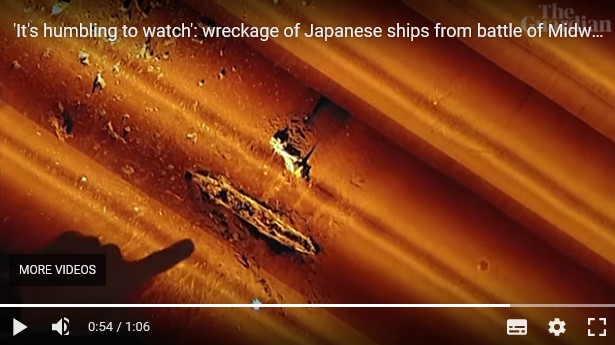
The Guardian informs me in this article that the plucky crew of the Petrel (again) have discovered
the wrecks of the Akagi and Kaga. So weâre seeing now that itâs this one ship, the Petrel, with this
one crew of guys making all the discoveries. This is obviously quite easy to control. Youâll forgive
me if Iâm not convinced when one of the Petrel crew points at this and goes âhereâs your proofâ:
The article informs us that the Akagi is (of course) found at a depth of 18,000 feet of water, 1,300
miles NW of Pearl Harbour and is a 33,000 tonne ship, so someone had fun getting ALL the
numbers in one article.
Wrapping up now we look at the section on Wikipedia for Midway talking about casualties, where
we read:
âBy the time the battle ended, 3,057 Japanese had died. Casualties aboard the four carriers were:
Akagi: 267; Kaga: 811; Hiryū: 392 (including Rear Admiral Tamon Yamaguchi who chose to go
down with his ship); Soryū: 711 (including Captain Yanagimoto, who chose to remain on board);
a total of 2,181. The heavy cruisers Mikuma (sunk; 700 casualties) and Mogami (badly damaged;
92) accounted for another 792 deaths.
In addition, the destroyers Arashio (bombed; 35) and Asashio (strafed by aircraft; 21) were both
damaged during the air attacks which sank Mikuma and caused further damage to Mogami.
Floatplanes were lost from the cruisers Chikuma (3) and Tone (2). Dead aboard the destroyers
Tanikaze (11), Arashi (1), Kazagumo (1) and the fleet oiler Akebono Maru (10) made up the
remaining 23 casualties.
At the end of the battle, the U.S. lost the carrier Yorktown and a destroyer, Hammann. 307
Americans had been killed, including Major General Clarence L. Tinker, Commander, 7th Air
Force, who personally led a bomber strike from Hawaii against the retreating Japanese forces on
7 June. He was killed when his aircraft crashed near Midway Island.â
Iâm going to need to do a âcorpse mathâ tally at the end of this series where I count up all the battles
Iâve demonstrated are fake and how many dead that reduces the war by. In the meantime, suffice to
say as we have absolutely no evidence that any Japanese were at Midway, let alone a naval battle,
we can conclude that nobody died. No ships were sunk (Iâll allow a possible for an old target-vessel
or an effective prop used by the navy if they wanted to leave some evidence but again I donât trust 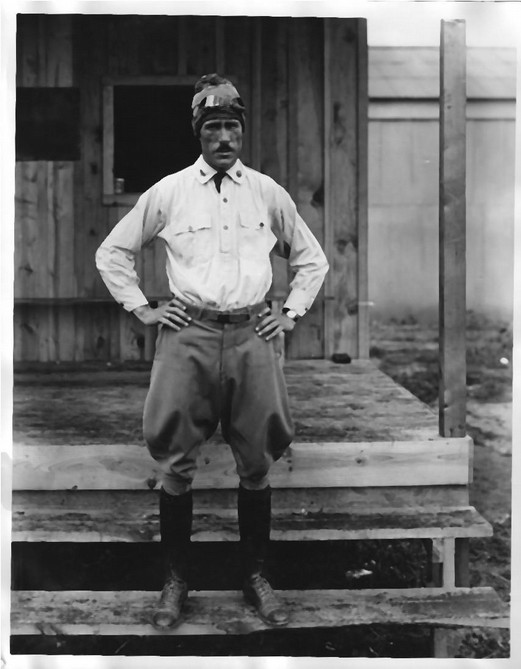
the Petrel to magically find everything and show me dodgy possibly-CGI images of wrecks as
proof).
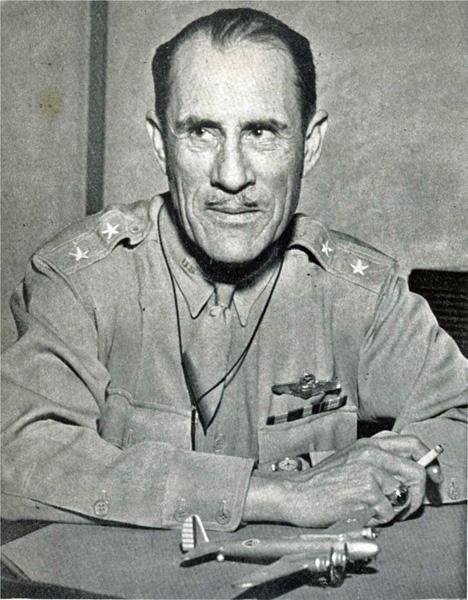
We can also deduce that Rear Admiral Tamon Yamaguchi and Captain Yanagimoto were both fed
up with playing soldier (seaman?) and bowed out of the production. Retirement villa, military
pension and an MKUltra Beta Kitten harem? Sounds good. The same would apply for Major
General Clarence L. Tinker of course. So letâs click on his link to see his page:
Another ridiculous asshole with a Hitler mustache. But what Allied General wouldn't want a Hitler
mustache in 1943?
Please also note under this section of the Midway page on the Discovery of Sunken Vessels that the
Yorktown (carrier lost by the Americans) was found by none other than Robert Ballard, who we
have seen before in previous Mathis papers âfindingâ the Titanic and the Bismarck. Itâs a small
world, isnât it?
Outro Music


_under_air_attack_during_the_Battle_of_the_Coral_Sea%2C_8_May_1942_(NH_95579).jpg)
_Philippine_Sea.jpg)
_is_near-missed_by_a_Japanese_bomb_during_the_Battle_of_the_Philippine_Sea%2C_19_June_1944_(80-G-366983).jpg)

_under_attack_by_dive_bombers_during_the_Battle_of_Santa_Cruz_Islands_on_26_October_1942_(80-G-20989).jpg)
_burning_on_15_September_1942_(80-G-16331).jpg)
_during_the_Battle_of_the_Santa_Cruz_Islands_on_26_October_1942_(80-G-33947).jpg)
_during_the_Battle_of_the_Santa_Cruz_Islands_on_26_October_1942.jpg)
_is_abandoned_in_the_late_afternoon_of_26_October_1942.jpg)